Infantino’s Waterloo and the decline of Western hegemon
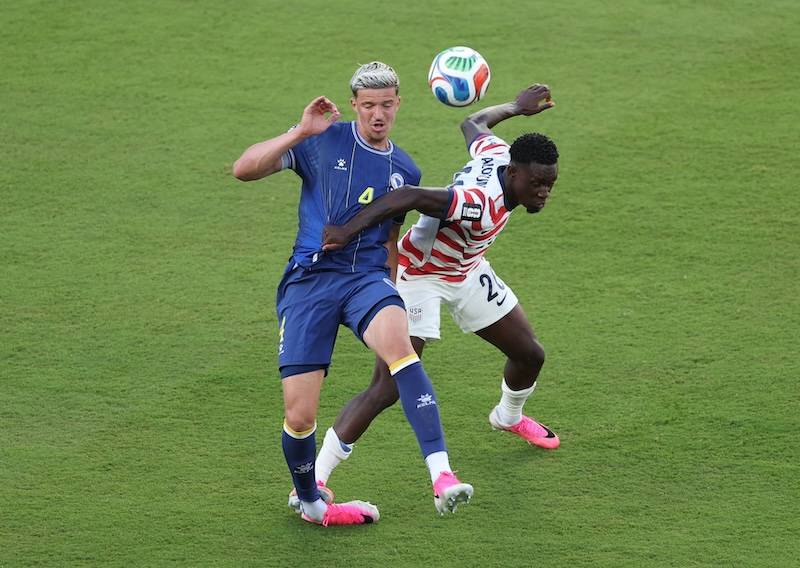
Folarin Balogun #20 of the United Stat fouls Tarik Muharemovic #4 of Bosnia and Herzegovina which is awarded as a red card foul a during the FIFA World Cup July 1, 2026. Judgment overturned later due to Trump / Infantino intervention. Michael Steele/Getty Images/AFP
The FIFA World Cup hosted by the United States, C
anada and Mexico is drawing to a close. It has been, in the century-long history of FIFA, both the most successful and the most controversial tournament ever staged. The expansion of participating teams and the number of matches set new records, as did attendance figures and commercial revenues. As FIFA’s ninth president, Gianni Infantino has every reason to celebrate what he would call a series of “historic achievements.”
Yet another undeniable reality has emerged: amid the chaos surrounding the tournament, people have sensed a growing crisis. Whether Infantino and his colleagues admit it publicly or not, this World Cup may well prove to be Infantino’s Waterloo—a turning point after which his once unquestioned authority in world football will never fully recover.
Regardless of Mr. Infantino’s motivations, it is difficult to ignore the extent to which he appeared eager to ingratiate himself with President Donald Trump, even to the point of disregarding long-established conventions governing the football arena. President Trump, for his part, accepted such deference without hesitation, much as he did in his interactions with the Italian prime minister. The immediate consequence was that both FIFA and its leadership found themselves ridiculed by public opinion as “a circus and its clown.”
Mr. Infantino may have countless explanations for why his actions were either necessary or ultimately beneficial. Yet these self-inflicted blunders—resembling spectacular own goals—have seriously undermined FIFA’s credibility. Unfortunately for the organization, this is no longer merely a perception but an objective reality. How deep and how lasting the damage will be remains impossible to determine.
In fact, the shift from overwhelming confidence to a collapse in credibility had already become apparent before the opening match of the World Cup. It was exposed during FIFA’s negotiations with China Media Group’s CCTV over broadcasting rights. Three years ago, FIFA had insisted on a non-negotiable asking price. But as the tournament approached, it ultimately accepted virtually all of CCTV’s terms. Although China’s national football team was mocked for failing to qualify for the tournament, Chinese media scored a decisive victory on another battlefield, teaching the once-arrogant FIFA and Mr. Infantino a painful lesson.
When FIFA Secretary General Mattias Grafström smiled for the cameras and declared that “our negotiations with CCTV were highly successful; it was a win-win outcome,” his uneasy expression, together with reports from various international media outlets, pointed to a widely shared conclusion: FIFA had ultimately backed down in its negotiations with the Chinese side. One month later, the World Cup began, yet the shadow cast by that defeat in the broadcasting-rights negotiations seemed to linger over FIFA. Many of Mr. Infantino’s subsequent missteps only reinforced that impression.
There is no denying Mr. Infantino’s enormous contributions to FIFA over the past decade, particularly his relentless drive to expand the commercial value of the game. Although, in President Trump’s eyes, he may not even qualify as an undergraduate, his underestimation of China’s strength today reflects the same misjudgment he has made about the world as it now stands.
Western civilization often invokes Socrates’ famous injunction, “Know thyself,” as a principle of self-reflection. Yet FIFA’s leadership has failed to recognize the profound transformation taking place in today’s world, or to understand how FIFA itself should respond to that transformation.
Ironically, not long after FIFA was compelled to sign a new broadcasting agreement with CCTV, congratulatory messages arrived for the president of China Media Group from the president of Ligue 1, the chairman of Paris Saint-Germain, and even the president of the International Olympic Committee. Publicly available information suggests that while these international sports organizations congratulated CCTV on securing the World Cup broadcasting rights, they devoted even greater attention to expressing their hope for deeper cooperation with Ligue 1, Paris Saint-Germain, and the IOC. This may not amount to schadenfreude at FIFA’s expense, but it certainly indicates that the influence and negotiating power of Chinese media have risen dramatically.
To be fair, FIFA’s negotiations with CCTV cannot be described as a complete defeat, since both parties ultimately characterized the agreement as mutually beneficial. Nevertheless, underestimating one’s counterpart and looking down upon one’s negotiating partner is a lesson not only for FIFA and Mr. Infantino but also for the broader Western world.
When China’s electric vehicles began gaining global popularity, many in the West mocked them as “nothing more than scrap metal without charging stations.” When China’s humanoid robots dazzled audiences during the Spring Festival Gala, Western commentators confidently dismissed the performance as “nothing but AI-generated tricks.” Only after reality repeatedly proved them wrong did many of these self-proclaimed experts lose confidence in their own predictions, with some even beginning to show signs of anxiety.
From one perspective, FIFA’s miscalculation over the World Cup broadcasting rights can also be viewed as part of a broader Western misjudgment of China in the new era. The decline of Western hegemony has not happened overnight; it has been unfolding for quite some time, even if many in Western societies remain reluctant to acknowledge it.
In reality, if people return to rationality, assess China’s rise objectively, engage with China on an equal footing, and treat this new and independent negotiating partner fairly, the possibilities for mutually beneficial and even multilateral cooperation will be virtually limitless. Believing in China’s future also means believing in our own future. After all, wasn’t the World Cup broadcasting agreement eventually reached?
This is, ultimately, a new era.
Bai Ruide